The meaning of stainless steel

The meaning of stainless steel:
Stainless steel refers to steel alloyed with at least 10.5% chromium, giving it corrosion resistance properties.
Stainless steel forms a thin, dense film of chromium oxide on its surface, protecting it from the external atmosphere.
Stainless Steel Groups
Stainless steel can be divided into five main groups based on its microstructure:
Ferritic stainless steel (ferritic grade)
Austenitic stainless steel (austenitic grade)
Duplex stainless steel (duplex grade)
Martensitic stainless steel (martensitic grade)
Precipitation-hardening stainless steel (precipitation-hardening grade)
Commonly used ferritic stainless steel contains approximately 12% or 17% chromium (Cr) (with a Cr content range of +/- 1%) and very little nickel (as present in the raw material).
This group of stainless steels has a ferrite microstructure and is magnetic. It has moderate yield strength and tensile strength.
Ferritic stainless steels, such as grades 430 and 409, have high elongation values. They are cheaper compared to austenitic stainless steels, but may experience grain coarsening and loss of toughness after welding. Applications include washing machine parts, exhaust pipe components, and some grades have high chromium content for high-temperature applications.
Common austenitic stainless steels contain approximately 17% chromium (Cr content range +/-1%) and 9% nickel (Ni content range +/-1%).
The addition of nickel distinguishes this group from ferritic steels by increasing corrosion resistance and maintaining an austenitic microstructure. Some grades of this group have additional chromium and nickel to improve oxidation resistance at high temperatures, making them suitable for blast furnace components. Austenitic steels exhibit better corrosion resistance than ferritic steels. In terms of mechanical properties, austenitic stainless steels have yield strengths similar to ferritic stainless steels.
However, they have higher tensile strength and elongation, making them very formable. These stainless steels are non-magnetic.
(In the annealed state), examples include grades 304, 316L, 321, and 301. Applications include pots, spoons, and trays.
Martensitic stainless steel contains approximately 11.5-18% chromium. This group of stainless steels has a suitable amount of carbon and can be hardened. These steels have very high yield strength and tensile strength, but low elongation. An example is grade 420. Applications include cutting tools and knives.
Duplex stainless steel has a structure composed of austenite and ferrite, with approximately 100% chromium. Containing 21-28% chromium and approximately 3-7.5% nickel, this group of steels has
high yield tensile strength and high elongation, thus possessing both high strength and ductility. Examples include grades 2304, 2205, and 2507.
Precipitation-hardened stainless steel, containing approximately 15-18% chromium and 3-8% nickel, is hardenable and therefore suitable for shafts,
pumps, and valve heads. Examples of this grade include PH13-9Mo and AM-350.
Effects of Alloying Elements
Carbon (C)
Carbon (C) is present in stainless steel, generally not exceeding 0.15% (except for martensitic stainless steel). Low-carbon stainless steel increases resistance to intergranular corrosion, improves cold formability, and enhances weldability. Most stainless steels are alloyed with carbon in two ranges: 0.02% (≤0.03%) and 0.07% (0.04-0.15%). Furthermore, the addition of titanium or niobium to stainless steel helps to bind with carbon and provides the same three aforementioned properties.
0.02% Carbon Stainless Steel: Stainless steel grades with the letter “L” control carbon to not exceed 0.03%, resulting in better weldability, resistance to intergranular corrosion, and higher cold formability compared to grades with higher carbon content.
Chromium (Cr)
Chromium (Cr) increases resistance to corrosion in general atmospheric conditions. It is present in stainless steel at a minimum of 10.5%. However, to ensure a uniform distribution of at least 10.5% chromium in the stainless steel, slightly higher concentrations are often used. Most stainless steels contain chromium in two ranges: 12% (10.5-14.0%) and 17% (16.0-24.0%). Containing more than 30% chromium makes the steel brittle.
Nickel (Ni)
Nickel (Ni) increases resistance to crevice corrosion in acidic solutions, improves cold forming capabilities, and enhances weldability. Most stainless steels…
Nickel is present in two ranges: 0% (a small amount is present in the steel) and 9% (6.0-15.0%).
Molybdenum (Mo)
Molybdenum (Mo) enhances the corrosion resistance of chromium, especially in anal corrosion, and also improves resistance to chloride corrosion.
Most stainless steels contain molybdenum in two ranges: 0% (a small amount is present in the steel) and 2% (1.0-3.0%).
Titanium (Ti) or Niobium (Nb)
Titanium (Ti) or niobium (Nb) improve resistance to intergranular corrosion. Both compounds prevent the formation of chromium carbide.
In addition, titanium and niobium improve cold formability and weldability.
Various surface finishes of stainless steel.

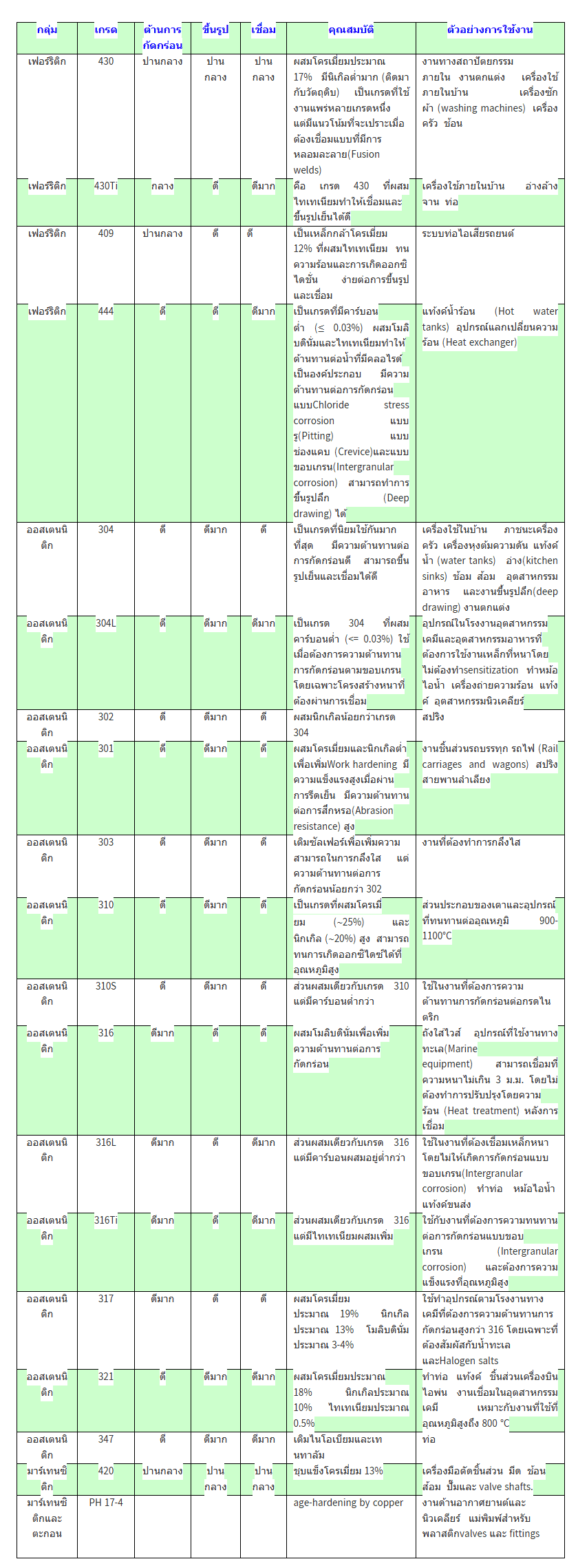
Selecting and using stainless steel.
The corrosion resistance, formability, and weldability properties of stainless steel can be categorized into different levels as follows:
Corrosion resistance
Moderate For example, contact with clean water or the rural atmosphere.
Good Examples include industrial water, urban atmosphere, and weak acids.
Very good Seawater, marine atmosphere, highly acidic.
Moldability
Moderate For general use.
Good Can stretch taller.
Very good Deep drawing
Welding capability
Moderate Work that does not require welding.
Good It can be welded in applications where there is no risk of grain boundary corrosion.
Very good It can be welded in applications with a risk of intergranular corrosion.